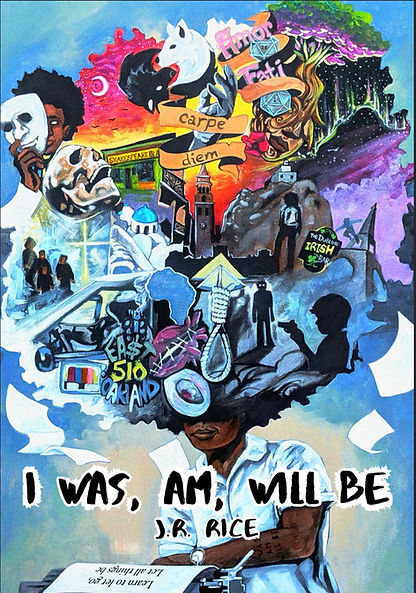
J.R. Rice

I Was, Am, Will Be
I Was, Am, Will Be is a powerful and deeply personal poetry collection about identity, growth, love, family, and the search for freedom. Through the voice of Jonah Tarver, J.R. Rice creates a journey that moves across Europe while remaining rooted in Oakland, California, and in the memories that shape a person’s sense of self.
The collection begins with Jonah leaving the United States after a period of profound change. His travels through Spain, Greece, France, and the Netherlands become a space for reflection and discovery. Rather than simply describing new places, the poems use travel as a way to explore what it means to carry one’s history, hopes, fears, and dreams into unfamiliar surroundings. The recurring statement “I was, am, and will be” gives the book its emotional center: identity is not fixed, but continuously formed through experience.
Rice’s writing is energetic, rhythmic, and intimate. His poems often move with the force of spoken word, combining repetition, rhyme, humor, cultural references, and direct conversation. This style makes the speaker feel immediate and present, as though he is inviting the reader into a private journal, a stage performance, and a personal letter at once.
A major strength of the collection is its commitment to writing as an act of survival, remembrance, and connection. In “Affirmations (Why-Write),” Rice presents writing as a necessary response to personal pain, community struggle, and the legacy of people denied the freedom to read and write. The poem transforms self-expression into a responsibility: to speak, to witness, and to create meaning where silence might otherwise take over.
The collection also gives considerable attention to family, particularly the bond between Jonah and his parents. “Last Letter (Ode-Dad)” and “Depends (Good-Night)” portray a father’s illness with tenderness, honesty, and enduring love. These pieces highlight the difficult changes that occur when a child becomes a caregiver, while also honoring memory as a way of preserving a loved one’s presence.
Poems such as “Who I Am (Remains)” and the closing “Sankofa (Faith > Doubt)” emphasize that a person can acknowledge pain without being defined by it. The collection ultimately celebrates the possibility of returning to one’s roots, reclaiming what has been forgotten, and continuing forward with purpose.
It is a book about becoming: learning to face the past, value one’s voice, and choose a future shaped by faith, memory, and self-belief.
Star rating: 5 Stars
Summary: A vivid, courageous collection that blends personal testimony with cultural reflection.